Almost every private kindergarten today lists English in its program description. But there’s a huge difference between a kindergarten where children truly acquire English — and one where they repeat “apple, banana, cat” once a week over a worksheet.
Parents can hardly tell the difference during a tour. This article is here to help.
Why Early Childhood Is Truly Special for Language Learning
There’s something linguists and neuroscientists call the “critical period” for language acquisition — roughly from birth to the age of seven or eight. During this period, the brain is literally “wired” differently for acquiring language than it is later in life.
What does that mean in practice?
A preschool child regularly exposed to English doesn’t learn English as a foreign language — they acquire it, the same way they acquired their mother tongue. Without grammar rules, without translating in their head, without fear of making mistakes.
Adults can’t do that. Teenagers can’t either. That’s exactly why the preschool years are a window worth using.
Acquisition vs. Learning — The Key Difference
This may be the most important thing to understand about children and languages.
Learning is conscious — grammar, vocabulary, rules. That’s how adults learn a foreign language.
Acquisition is unconscious — the child absorbs language through context, repetition, and interaction. That’s how children learn their mother tongue.
Preschool children cannot “learn” English the way it’s done in school — their brains aren’t ready for that yet. But they can acquire it — if the conditions are right.
The conditions are: enough exposure, in the right context, through play and interaction.
What Actually Works in Kindergarten
A good English program in kindergarten looks like this:
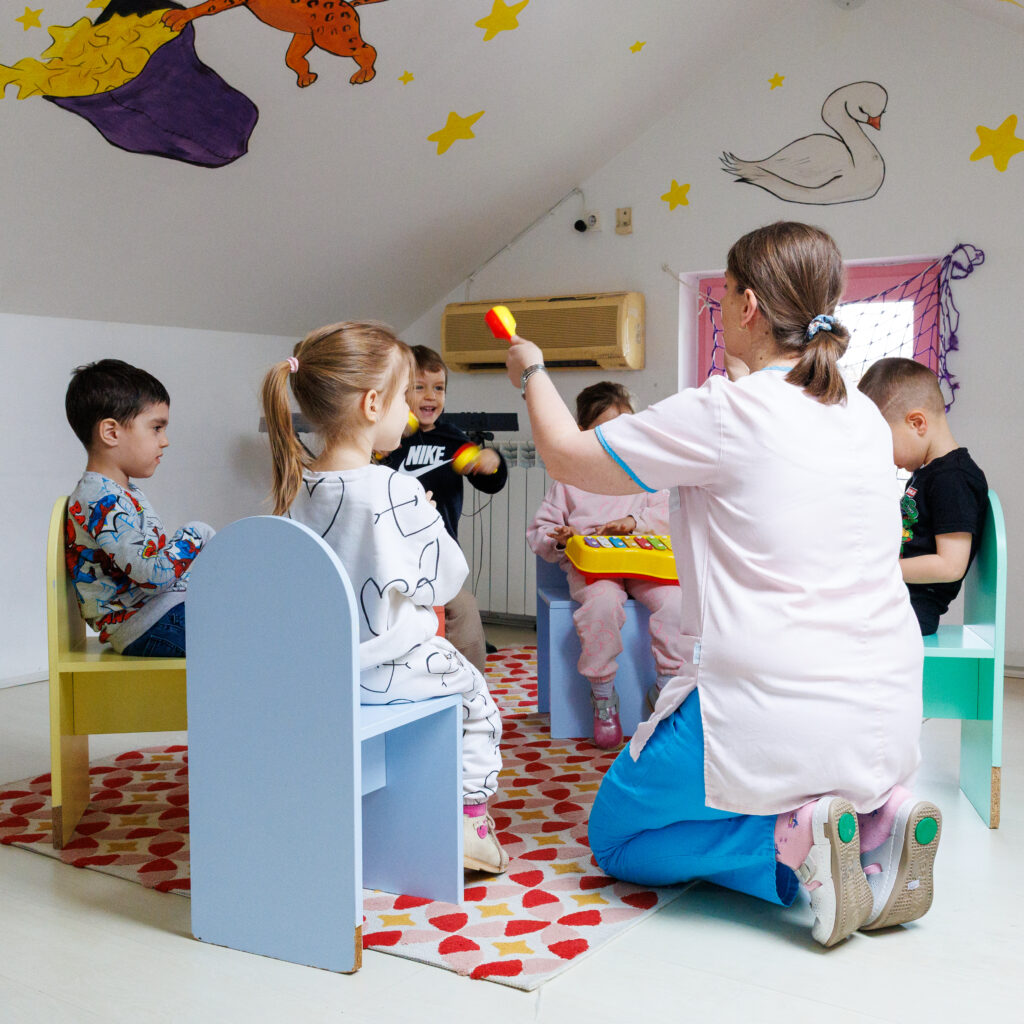
English is woven into the day, not separated from it. The teacher gives instructions in English during play, sings songs, reads stories, names objects in passing. Children hear English in a natural context — not just during a “lesson.”
No pressure to speak. Children go through a silent acquisition phase — they understand far more than they can say. A kindergarten that insists a child “say it in English” before they’re ready creates anxiety, not knowledge.
Repetition through routine. “Good morning,” “wash your hands,” “time to eat” — the same phrases, every day, in the same context. That’s how a child’s brain builds strong associations.
Songs, rhymes, and movement games. Rhythm and movement aid memory. A child who has sung “Head, Shoulders, Knees and Toes” a hundred times knows those words forever.
What Does NOT Work
Worksheets and repeating words without context. “Repeat after me: apple.” The child will repeat it — and forget it in five minutes.
English only at a set time. If children hear English only on Fridays at 10 a.m. — that’s far too little for acquisition to happen.
The translation approach. “Apple means jabuka.” This teaches children to translate in their heads — the exact opposite of what we want.
Too early, too formal. A two-year-old doesn’t need an “English lesson” — they need a teacher who naturally speaks English during play.
Will the Child “Mix Up” the Languages?
This is the question parents ask most often — and the answer is: yes, they will. And it’s completely normal.
Bilingual children go through a language-mixing phase (code-switching) that worries parents but not experts. It’s a sign that the brain is actively processing both systems — not a sign of confusion.
Studies consistently show that bilingual children, although they sometimes have a smaller vocabulary in each language individually, have better cognitive flexibility, better attention, and learn third languages more easily later in life.
What to Ask the Kindergarten About Its English Program
Before you trust the numbers in the brochure, ask:
- “Does the teacher speak English with the children throughout the day, or only at a scheduled time?”
- “How is English integrated into everyday activities?”
- “Do the children have the opportunity to hear a native speaker?”
- “Can we see an example of an activity in English?”
A kindergarten with a good program will answer these questions concretely and with ease.
What You Can Do at Home
Kindergarten is only one piece of the puzzle. If you want to support English learning at home, you don’t need to know English yourself.
- Play English songs during the morning routine or in the car
- Choose cartoons in English, with Serbian subtitles or without them
- Read picture books in English — even if you read phonetically
- Don’t translate every unfamiliar word — let context do the work
Children are remarkably capable of extracting meaning from context. Trust that process.
An Early Start Is Not a Guarantee — Quality Is
A kindergarten that writes “English from age one” in its brochure without a clear methodological approach guarantees you nothing.
An early start is an advantage only if the program is well designed. A child who “had English” for five years at a kindergarten where it amounted to a weekly worksheet will be no better off than a child who started school with no prior instruction at all.
Ask, observe, request concrete examples. The quality of the program matters more than how many months old the child was when it started.
Want to learn more about our approach to English and what a typical day at our kindergarten looks like? Get in touch — we’re happy to answer all your questions.