
When a child stands on one leg, waves their arms, and shouts, “Look at me!”, it may seem like they’re just playing. But in that very moment, they’re actually learning—something incredibly important.
Balance and coordination aren’t just physical skills. They’re the foundation for many aspects of a child’s development: from walking and running, to sitting still, writing, playing, and even learning.
What’s Really Happening When a Child “Balances”?
Balance is a complex skill. For a child to stay upright—whether standing on one foot or walking along a line—they must use multiple body systems at once:
-
The inner ear for balance,
-
The eyes for orientation,
-
The muscles for stability, and
-
The brain to coordinate it all.
Coordination is the next step—it’s the ability to make different parts of the body work together smoothly. Whether catching a ball, running without tripping, or jumping across a puddle, these movements take time and practice to develop—and that’s where play comes in.
Games That Support Balance and Coordination – Simple and Effective
At Mega Kids preschool, we encourage motor development through everyday games that may seem simple but are carefully designed to strengthen balance, coordination, and spatial awareness. Here are a few you can easily try at home:
1. Walking the Line
Use tape to create a line on the floor and turn it into a “balance beam.” Ask your child to walk forward, backward, on tiptoes, or while holding a toy. It seems easy—but it takes focus and control.
2. Spoon Race
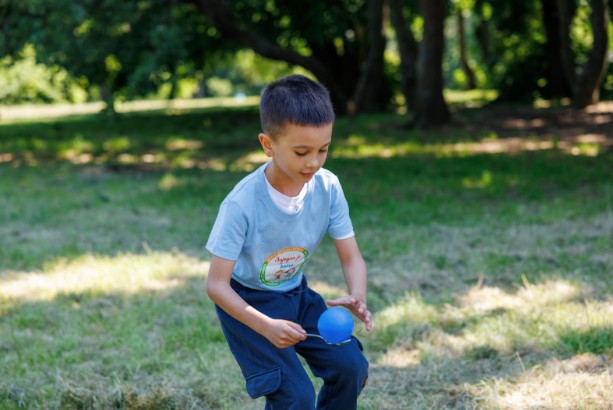
Have your child carry a ball (or plastic egg) on a spoon from point A to point B. Add more children for extra fun! This classic game builds balance, precision, and self-control.
3. Airplane Challenge
Stand on one foot with arms out like airplane wings. Add challenges like: “Close your eyes,” “Touch your nose,” or “Spin in a circle.” These activities sharpen body awareness and balance.
4. Island Hopping
Place pillows or paper “islands” on the floor and have your child jump from one to the next without touching the “water.” This boosts coordination and movement planning.
5. Follow the Hidden Commands
Give fun spatial instructions like: “Hide under,” “Stand behind,” or “Touch something above your head.” These games help children build spatial orientation—and they absolutely love it.
The Right Environment Makes a Difference
All of these games are even more enjoyable when children have space to move, jump, and explore safely. That’s why many parents choose play centers designed to support motor development—like Avocado playroom, a party and play space where children can move freely and develop coordination, balance, and spatial awareness through joyful play.
Why Is Balance So Important?
A child who develops good balance and coordination is more likely to:
-
Navigate spaces safely and confidently
-
Move with control and ease
-
Focus and learn more successfully
-
Perform daily activities independently
And most importantly—they feel capable and free to explore the world around them.
Small Movements, Big Development
Developing balance doesn’t require structured workouts. All it takes is daily play, movement, falling, and getting back up.
Each time your child jumps, balances, or discovers “which way is up,” they’re building not just physical strength—but also mental confidence.
So next time your little one runs across the yard with a spoon and a very serious expression, trying not to spill what they’re carrying—remember: this isn’t just play.
In that moment, they are learning to balance—in every sense of the word.