
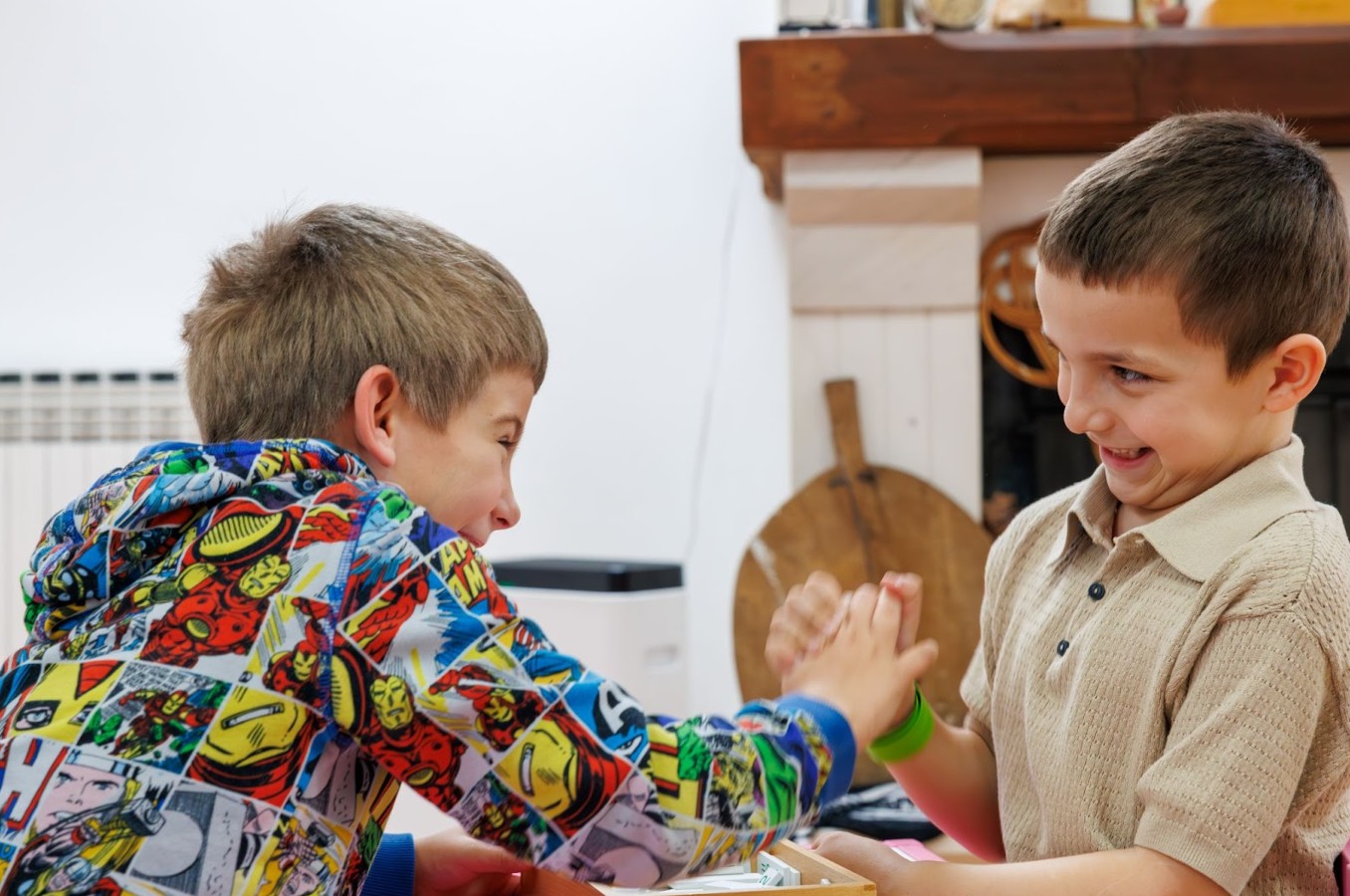
You know that moment when a child, using various objects held up to their ear, mimics talking on the phone — and laughs as if they just came up with the funniest joke in the world? That moment is not just fun. It is important. Because right then, while laughing, the child is doing something much bigger: understanding the world, testing rules, and finding their place in it.
Humor Starts Earlier Than We Think
The first smiles appear in the first months of life, but a sense of humor — that “something funny” — begins to develop around the age of two. At that age, children discover they can surprise, confuse, or make adults laugh. And they like it.
In preschool age, humor becomes more creative: wordplay, jokes, twisting expected norms (for example, a dog saying “meow”). All this shows that the child not only understands rules — but can also turn them upside down, which is a sign of cognitive progress.
What Do Children Learn Through Laughter?
-
Emotion regulation: Children use humor to cope with fear or discomfort. Laughter eases facing unpleasant situations.
-
Social skills: Through jokes, they connect with others, learn to read reactions, share attention, and build relationships.
-
Creativity and thinking: Understanding a joke requires the ability for abstract thinking, recognizing contrasts, and hidden meanings.
In other words, when a child jokes — they are actually practicing empathy, flexibility, and emotional expression. Not bad, right?
Laughter as a Signal: “I Understand This. I Am Safe Here.”
Children cannot laugh if they do not feel safe. Humor comes only when basic emotional needs are met. That’s why it often happens that a child in a new environment, like kindergarten, first observes — until one day they make a funny face or say something silly. That’s not accidental. It’s a sign they have relaxed.
How Can Parents Encourage Humor?
-
Laugh together, even when it’s not funny to you.
-
Allow imitation and joking — it has its place and purpose.
-
Don’t correct every inaccuracy in jokes. They don’t always have to be logical.
-
Use humor in everyday situations — during dressing, feeding, bedtime routines. Sometimes emotions open up the most at those times.
No Need for Everything to Be Serious
In a serious world full of rules, schedules, and expectations, children use humor as refreshment. Laughter is their way to cope with confusing situations, brighten the day, and be seen.
Sometimes they’ll say something completely illogical and burst out laughing, expecting you to follow along. Sometimes they’ll laugh hiding under the table, convinced they are invisible. And in those moments, more than ever, laughter becomes a call — not only to participate, but to understand it.
You don’t always have to be funny. It’s enough not to be afraid to laugh together.