
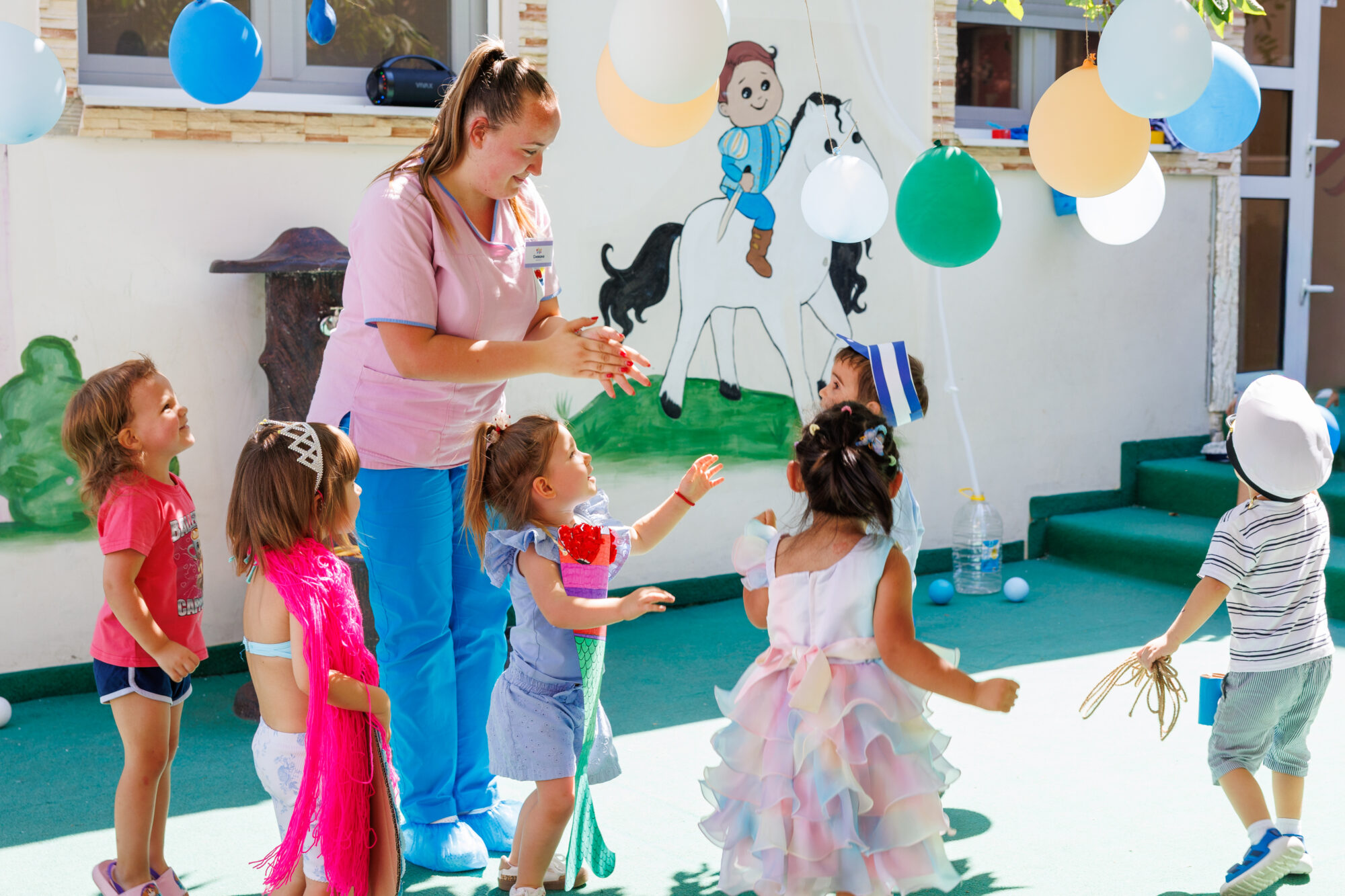
Every preschool group has its own little rituals – shared songs, circle games, dances, dramatizations. While some children can’t wait to line up with their peers, others prefer to stay on the sidelines. This often makes parents worry: “Is something wrong?” “Does my child have a socialization problem?”
Истина је да одбијање групних активности не мора да значи ништа лоше. Оно нам често само говори нешто више о темпераменту и тренутним потребама детета.
The truth is, a child’s refusal to take part in group activities doesn’t necessarily mean anything bad. It often simply reflects their temperament or current needs.
Why do some children withdraw?
There can be many reasons:
-
Temperament – Introverted children naturally prefer small-group or individual activities.
-
Insecurity – If the activity is new or involves performing in front of others (singing, acting), the child might fear making a mistake.
-
Developmental phase – Younger children may not yet have the social skills needed for group cooperation.
-
Past experiences – If a child has previously been mocked or corrected in front of a group, they might lose the motivation to participate.
What does a child learn just by observing?
Even when they’re not actively participating, a child is still learning:
-
By observing, they learn the rules of the game.
-
By listening, they absorb vocabulary, rhythm, and the sequence of activities.
-
Through empathy, they learn how others experience joy or cope with mistakes.
In other words, being on the sidelines doesn’t mean a child isn’t engaging at all.
How can parents help?
-
Don’t force participation – Pushing can create even more resistance.
-
Praise observation – Say: “I see you’re really watching the game closely.”
-
Offer choices – Let your child participate in their own way (e.g. holding a prop or helping the teacher).
-
Practice at home – It’s easier for a child to try out an activity in the comfort of home first.
-
Build confidence patiently – Sometimes all a child needs is time and gentle support to take that first step.
If you notice your child finds it easier to join in small groups or familiar settings, you can gradually encourage them through social play in warm, supportive environments – like Avocado Playroom, for example.
There, they’ll have the chance to learn how to share and cooperate with others in a gentle, pressure-free way.
A message to parents
Remember – group activities are not a race. Every child joins in when they feel ready.
Your role isn’t to push them into the circle, but to give them the support and belief that one day, they’ll want to join on their own.
And when that moment comes, the joy of their first step into group play will be even greater – for your child, and for you.